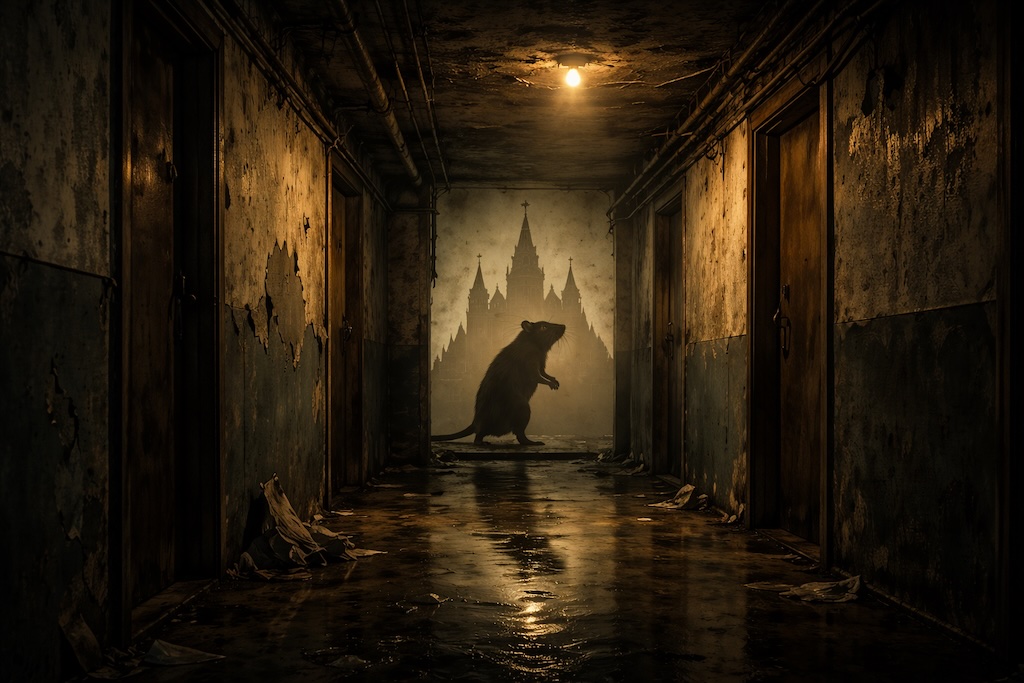
In 1989, when Vladimir Putin asked Moscow for help and got no response, something inside him broke. He thought about the rat that had trapped a child and realized that in the new world being born, you would either be the one who attacked or the one who had no way out.
This is the story of the man who promised that Moscow would never be quiet again, from the wheel of a taxi to the throne of the "New Tsar."
A Rat Taught Me Something Important
In his book First Person, which came out in 2000, right after he became president, Vladimir Putin tells a story from his childhood that would shape his view of life.
Little Vova spent his time chasing mice with a stick in the hallways of the old kommunalka (communal apartment) at 12 Baskov Lane in what was then Leningrad. The hallways smelled like moldy, boiled cabbage and damp. There was no hot water or bathtub in the building, and the family shared a kitchen and bathroom with their neighbors. Rats and cockroaches were always around.
One day, he caught a big rat. There was no way for the animal to get away. Then, instead of giving up, it jumped at him and tried to hit him in the face. Putin was able to slam the door shut at the last minute.
He later wrote, "That's where I learned what it means to corner someone." "When you trap someone and they can't get away, they'll turn around and fight you with all their strength."
The lesson was clear and harsh: the most dangerous enemy is the one who has nothing to lose. This logic seems to run through his whole career, from the damp hallways of a falling-down apartment building in Leningrad to the gold-plated offices of the Kremlin. It affects how he handles problems, fights, and enemies. It also shows something else: Putin doesn't see himself as the hunter but as the rat. The animal that becomes deadly when caught.
A Hard Childhood Made by War
Vladimir Vladimirovich Putin was born on October 7, 1952, into a poor Soviet family that had a lot of bad things happen to them. His parents, Vladimir Spiridonovich Putin and Maria Ivanovna Shelomova, had already lost two sons: little Viktor, who died in 1942 during the Siege of Leningrad from diphtheria in a city that was short on food and medicine, and another boy who had died earlier, as a baby. Vladimir was their surprise late child, born when his mother was 41 and his father was 47. He was a gift after they lost something they couldn't have imagined.
The Siege of Leningrad wasn't just a chapter in a book. From September 1941 to January 1944, Nazi forces blocked the area for 872 days, killing between 800,000 and 1.5 million civilians, mostly from hunger and cold. It was a family memory that was burned into every meal, every loaf of bread, and every winter. His father, Vladimir Sr., was in the NKVD's demolition battalion and was badly hurt in 1942 when a grenade blew up his legs on the Nevsky Pyatachok bridgehead, which was one of the war's bloodiest places, where tens of thousands of Soviet soldiers died trying to break the siege. For the rest of his life, he walked with a limp.
Maria, his mother, had wounds that were not visible. During the blockade, she almost died from starvation. She survived on boiled leather and wallpaper paste, like many other Leningraders. Putin says that she passed out from being too tired and was thought to be dead. When her father got back from the front with a wound, he saw that she was still alive and saved her at the last possible moment. She had already been put in a mass grave with other dead bodies. It is a story that feels like a myth, and whether it is completely true or made up by family retelling it, it gave Putin a deep understanding of how to survive against all odds.
Vova lived in a small apartment in a city that was still healing. In the 1950s and 1960s, Leningrad was a city with rebuilt facades that hid empty interiors, just like the Soviet Union itself. People who were the toughest made the rules in the courtyards and stairwells. To stay alive, you needed quick reflexes, strong fists, and the will to fight boys who were bigger and older. Putin was small for his age; he would only grow to be about 5'7". To make up for it, he was aggressive. He said himself that he was a bad student and a troublemaker who almost didn't get into the Young Pioneers because of his bad behavior.
He would later say, in his usual blunt way, "The street taught me one thing: if a fight is coming, hit first."
He learned the most in the courtyard, not in the classroom. This same logic, using force before it happens, being in charge, and never showing weakness—would later shape his foreign policy.
"I Want to Be an Agent"
When he was sixteen, most of his friends wanted to be engineers or cosmonauts, but young Vladimir Putin made a choice that even people in the Soviet Union thought was strange. He went to the KGB's Leningrad headquarters, the Bolshoy Dom ("Big House") on Liteyny Prospekt, which had a scary reputation, and asked what it took to be a spy.
The officer who met him was confused but professional. The answer was cold and clear: get a law degree, stay in great shape, be completely disciplined, and don't get in touch with us again. We will get in touch with you.
Putin did all of these things. In 1970, he started studying law at Leningrad State University and also started training in martial arts, first in sambo (a Soviet combat sport) and then in judo. He won the city's judo championship in 1976 and went on to get a black belt, which was a real athletic achievement that later became a big part of his political image. Anatoly Rakhlin, his judo coach, was one of his closest friends until Rakhlin died in 2013. Putin has said many times that judo taught him how to control himself, be patient, and use an opponent's strength against them.
He joined the KGB right after finishing his law studies in 1975. At its peak, this was not just an intelligence service; it was the Soviet Union's nervous system, with about 480,000 officers and millions of informants. Putin learned there that information is a weapon, patience is a strategy, and control, not noise, is how to handle crises. He learned that people use power behind closed doors and that the state's weakness should never be shown to the outside world.
He worked in counterintelligence in Leningrad at the start of his career. It wasn't very glamorous work, but it involved keeping an eye on foreigners and finding informants. His most important job came in 1985 when he was sent to Dresden, East Germany. It wasn't the famous Berlin or Vienna station. Dresden was a backwater, a second-tier job. His job was to talk to the Stasi (East Germany's feared secret police) and, according to reports, try to recruit Western students and businesspeople. His work has been called competent but not very interesting by former coworkers. He was a lieutenant colonel when the world around him started to fall apart.
When Moscow Went Silent—The Moment His World Fell Apart
Dresden was cold on the night of December 5, 1989. Less than a month before, on November 9, the Berlin Wall had fallen, and now the revolution was spreading. After the old order fell apart, a lot of East German protesters gathered outside the Stasi headquarters in Dresden. Some people then looked at the KGB's nearby compound.
Putin, who was said to be one of the few officers still in the building, went outside to face the crowd. He said that he told the protesters that the building was Soviet land and that his men were armed and ready to shoot. The crowd waited a moment and then left.
But the moment that really hurt him happened before that fight. As things got worse, Putin called the Soviet military command in Dresden for advice. The answer was terrible: "Moscow is silent."
No orders. No help. No backup. The empire was falling apart, and no one in the center was in charge. The superpower that had controlled half of Europe couldn't come up with a clear answer to a crowd of civilians in a medium-sized German city.
Putin later called the fall of the Soviet Union "the greatest geopolitical catastrophe of the 20th century." This shocked people in the West, who thought that title belonged to the World Wars or the Holocaust, but it struck a chord with millions of Russians who saw the 1990s as a decade of national shame.
Reports say that in the last few days of his life, he was in Dresden burning classified documents. He burned so many that the stove broke. He took what was left to Moscow when there was nothing else to destroy. From then on, restoring state authority would not only be a policy goal, but also a personal obsession. Moscow would never be quiet again.
Back to Chaos: From the KGB to the Taxi Driver
Putin's country was dying when he got back from Dresden in early 1990. The Soviet Union would officially end on December 26, 1991, but the process of falling apart was already well underway. The KGB was being reorganized, given a new name, and made smaller. Officers who had been at the top of the Soviet system suddenly felt lost.
Putin has said that during this time he had to work as a "gypsy cab" driver, which is what Russians called unlicensed drivers, to make ends meet and feed his family. He had married Lyudmila Alexandrovna Shkrebneva, a flight attendant from Kaliningrad, in 1983 after dating her for three and a half years. Maria (born in 1985) and Katerina (born in 1986) were their daughters. They were young children who needed to be fed in a country where hyperinflation was wiping out savings overnight.
It is very strange to see the former KGB officer driving a beat-up Volga sedan through the pothole-filled streets of St. Petersburg, picking up fares for a few rubles. This is very different from the imperial splendor he later showed.
The "Putin's Palace" in Gelendzhik, on the Black Sea coast, is on the other side of that mirror. The late opposition leader Alexei Navalny's 2021 investigation, which got more than 128 million views on YouTube, revealed the compound. It is said to be a 17,691-square-meter estate that cost more than $1.35 billion. According to architectural plans, it has a private ice rink, a vineyard, a casino, an amphitheater, a church, and even a strip club that is called a "hookah lounge." Putin said he didn't own the property, and the Kremlin said it belonged to different businessmen. However, the investigation found a network of shell companies and friends that led back to the president's inner circle.
For the man who used to have nothing, owning Russia itself, its resources, its government, and its oligarchic wealth, was the best way to make sure he would never have to "scrape by" again.
The "Accidental" Rise and Yeltsin's Bet
Vladimir Putin's rise to power is still one of the most amazing examples of political change in modern history. In less than ten years, he went from being a little-known KGB officer in a small East German city to being in charge of a nuclear superpower.
In 1990, he got a job in the administration of Anatoly Sobchak, the charismatic and reform-minded mayor of St. Petersburg. This changed his luck. Putin officially went back to the university to work in the international affairs office, but Sobchak quickly hired him as a close aide. Putin became the "fixer" there, the man who got things done behind the scenes. He earned the nickname "the German" because of his famous discipline, punctuality, and emotional reserve. He was in charge of foreign investment and relations with other countries. This put him in touch with big Western companies that wanted to do business in Russia after the fall of the Soviet Union. Some of these early deals were looked into later. For example, a 1992 investigation by the St. Petersburg city council accused Putin of giving out export licenses for metals and goods in exchange for food imports that never fully happened. This scheme is said to have cost the city tens of millions of dollars. The investigation was put on hold without anyone knowing.
When Sobchak lost the 1996 mayoral election to his deputy, Vladimir Yakovlev, Putin was given a job in the new government. He said no, saying, "Better to be hanged for loyalty than rewarded for betrayal."
The phrase made him look like a principled man, or at least a man who knew that loyalty is the most important thing in Russian politics.
He moved to Moscow the same year and started working for Pavel Borodin in the Presidential Property Management Department. Russia was falling apart under Boris Yeltsin. The president himself was sick with heart disease and alcoholism, had low approval ratings, and his "Family," the small group of oligarchs and advisors around him, was under investigation for corruption. Yeltsin was desperately looking for a "loyal soldier" who could keep the inner circle safe and help with the change of power.
Putin showed how valuable he was by passing a series of increasingly difficult tests of loyalty and ruthlessness. As head of the FSB (the KGB's successor in Russia) from 1998, he got rid of Yuri Skuratov, the general prosecutor who was looking into the Yeltsin family's money. The method was simple but worked: a secretly recorded video showed a man who looked like Skuratov in bed with two young women who were known to be sex workers. Putin went on national TV to say that the video was real. Skuratov had to step down. Putin was now the man the Kremlin could count on to solve the worst problems without saying a word and with perfect precision.
His rise was so fast that it made him dizzy:
In July 1998, he was named Director of the FSB.
March 1999: Became Secretary of the Security Council while still being in charge of the FSB.
Yeltsin named him Prime Minister on August 9, 1999. He was the fifth prime minister in 17 months.
On December 31, 1999, Yeltsin steps down in a dramatic New Year's Eve speech that is broadcast live across the country. Putin becomes Acting President.
What was Putin's first official act? He signed Decree No. 1, which gave Boris Yeltsin and his family full immunity from being charged with a crime. It was the clearest signal: loyalty would be rewarded, and the new president knew that Russian power was based on transactions.
The Baptism of Fire: Bombings in Apartments and Chechnya
In September 1999, when few Russians knew who Putin was, a wave of terror hit the country. In Moscow, Buynaksk, and Volgodonsk, bombs went off in apartment buildings, killing 293 people and hurting more than 1,000. In the middle of the night, entire residential blocks were turned into piles of rubble, killing and burying the people who lived there.
Putin quickly blamed Chechen separatists. His words shocked the West but thrilled ordinary Russians, who were tired of years of chaos and humiliation. He promised revenge: "We will hunt them down everywhere. " We will kill them in the outhouse if we find them in the toilet.
But the bombings were overshadowed by very troubling questions that have never been fully answered. On September 22, 1999, people living in an apartment building in the city of Ryazan saw people carrying big bags into the basement that looked suspicious. They called the police. They found what looked like hexogen (RDX), a military-grade explosive, connected to a detonator. People left the building. Two people were arrested, and they turned out to be FSB agents. The official story changed quickly. At first, FSB Director Nikolai Patrushev said he wasn't involved, but then he said the whole thing was a "training exercise" using sugar. There was never a clear release of independent testing of the substance. Critics who said that the FSB planned or helped with the bombings to start a new war in Chechnya and get Putin elected used the Ryazan incident as the most explosive piece of evidence. Journalists and Duma members who looked into the bombings had terrible things happen to them. Liberal Duma member Yuri Shchekochikhin died of a strange illness in 2003. Investigative journalist Anna Politkovskaya was killed in 2006. Former FSB officer Alexander Litvinenko, who publicly blamed the FSB for the bombings, was poisoned with radioactive polonium-210 in London in 2006.
No matter who was to blame, the political effect was quick and strong. Putin's answer was the Second Chechen War, which started in October 1999. Russian troops bombed Grozny, the capital of Chechnya, into a pile of rubble. In 2003, the UN said the city was the "most destroyed city on Earth." There are estimates that between 25,000 and 50,000 civilians died. Thousands of Chechen men "disappeared" into filtration camps where torture was common. The war left behind a generation of orphans, refugees, and radicalized fighters, and it turned Vladimir Putin into a national hero.
In just a few months, his approval ratings went from 2% to more than 45%. In the presidential election of March 2000, he won the first round with 53% of the vote.
The "taxi driver" from St. Petersburg had become the warlord that Russia had been waiting for, the man who made them feel safe again. Many analysts say that dark autumn of 1999 was when Putin "came to life" politically, rising from the ashes of a war that he had planned as the last battle for the state's survival.
"Who is Mr. Putin?"
At the World Economic Forum in Davos in January 2000, journalist Trudy Rubin asked the question that would bother the West for 25 years: "Who is Mr. Putin?"
The Russian delegation was silent and cold for a while. No one could say anything about the man who had just taken over the world's biggest nuclear stockpile.
The phrase became famous as a sign of how the West failed to understand, predict, or respond properly to the man in the Kremlin. In the years that followed, Western leaders would put their own hopes on Putin's blank-faced pragmatism: People remember George W. Bush saying he "got a sense of Putin's soul" when he looked into his eyes. Tony Blair worked with him as a partner, and Gerhard Schröder became a personal friend and later joined the boards of Russian energy companies Rosneft and Nord Stream, which caused a lot of anger. He went on vacation with Silvio Berlusconi. Emmanuel Macron tried to "reset" things as recently as 2022, just days before Russia invaded Ukraine.
The West thought it was dealing with a logical, businesslike partner who could be included in the liberal international order every time. It found out too late each time that Putin's point of view was not the post-Cold War consensus, but the world of empires, spheres of influence, and great-power competition before 1914.
The Consolidation: Breaking Up the Oligarchs and the Free Press
During Putin's first term (2000–2004), he ran a systematic campaign to take back control of the institutions that had broken down under Yeltsin.
The oligarchs, a small group of businessmen who got rich through the rigged privatizations of the 1990s, were told clearly that they had to stay out of politics and keep their money. If they did, they would lose everything.
Mikhail Khodorkovsky, who used to be Russia's richest man and the CEO of the oil company Yukos, was the most dramatic example. Khodorkovsky had started giving money to opposition parties and openly criticizing Putin's policies. He was arrested in October 2003 for tax evasion and fraud. He was given nine years in a Siberian prison colony after a trial that many people said was politically motivated. The state-owned company Rosneft took over Yukos's most valuable assets after it was broken up. Khodorkovsky was in prison for ten years before being set free and sent to live in another country in 2013.
There was no doubt in the minds of Russia's business elite that the Kremlin was the most important partner in every relationship. Oligarchs who knew this, like Roman Abramovich, Alisher Usmanov, and later Yevgeny Prigozhin, did well. Those who didn't were killed.
At the same time, Putin went after independent media. In 2001, the state-controlled energy company Gazprom bought NTV, Russia's last major independent TV network. The network was known for its satirical puppet show Kukly, which often made fun of Putin. They fired or moved its reporters. Other places followed. By the end of Putin's second term, either the state owned or Kremlin-friendly businessmen ran all of the major TV networks. Russian strategists call the "information space" safe.
The "New Tsar" Rises: Changing the Constitution
Vladimir Putin started an unprecedented political dance in 2000 to get around constitutional roadblocks and turn the Russian presidency into a throne that would never end.
The 2008 "Castling": Putin did not step down from power when the Constitution said he couldn't run for a third term. He did what the Russians sarcastically called the "rokirovka," which is a chess term for "castling." He switched places with Dmitry Medvedev, his protégé, who became president while Putin became prime minister. Medvedev dutifully kept Putin's seat warm for four years, extending the presidential term from four to six years through a constitutional amendment, before stepping aside in 2012 to let Putin return to the presidency. The deal was so clear that Medvedev announced it to the public at a United Russia party congress, confirming that the switch had been agreed upon years before.
The 2020 Constitutional Revision: Putin changed the Constitution to "reset" his presidential term count during a wide-ranging referendum held during the COVID-19 pandemic, when it was almost impossible for people to watch the vote independently. The change let him run for two more six-year terms, which could have kept him in power until 2036, when he would be 83 years old. The referendum also included conservative social values, like a ban on same-sex marriage and a mention of Russians' "faith in God." This showed that Putin was close to the Russian Orthodox Church and traditionalist ideas.
Putin doesn't want to hold on to power for its own sake; he wants to close what he calls an "open wound": the post-Soviet order. He has made it clear that Russia will get back its sphere of influence, even if it means destroying the global security system that has been in place since 1945. This is what happened in the war with Georgia in 2008, the annexation of Crimea in 2014, and the full-scale invasion of Ukraine in 2022.
The Wars: Ukraine, Crimea, and Georgia
Putin's use of military force is a big part of his foreign policy.
Georgia (2008): Russia started a five-day war against Georgia in August 2008, claiming it was to protect the breakaway regions of South Ossetia and Abkhazia. Russian troops beat the Georgian army and moved within 30 miles of Tbilisi. The West spoke out against it but did nothing useful. Putin came to the conclusion that military fait accompli worked.
Crimea (2014): After the Euromaidan revolution in Ukraine overthrew the pro-Russian President Viktor Yanukovych, Putin sent soldiers without insignia, known as "little green men," to take Crimea. A quickly put together referendum, held while the military was in charge, got a ridiculous 97% vote in favor of joining Russia. The annexation was the first time since World War II that a country in Europe took land by force. Western sanctions came next, but they were designed to punish without starting a fight. Putin saw this as a sign of weakness.
Ukraine (2022–present): Putin started a full-scale invasion of Ukraine on February 24, 2022. This was the biggest military operation in Europe since 1945. The first attack, which was a multi-axis invasion meant to kill the Ukrainian government within days, failed spectacularly. President Volodymyr Zelensky led the Ukrainian resistance, which was much stronger than Russian intelligence had thought it would be. The war has since turned into a long, drawn-out fight. Both sides have suffered a lot of casualties: Western estimates say that more than 200,000 Russian soldiers have died or been hurt, and Ukrainian losses have also been high. The war has caused the biggest refugee crisis in Europe since World War II, with more than 6 million Ukrainians fleeing to other countries. It has also changed global energy markets, strengthened NATO, and made Finland and Sweden join the alliance after decades of staying neutral, which is the exact opposite of what Putin wanted.
The Ideology of "Greater Russia"
Putin has changed Russia in his own image, turning it from a country in crisis into a revisionist power driven by historical grievance. He has done this through laws, decrees, and military operations.
His doctrine is not only political; it is civilizational. It is based on the idea of Russkiy Mir, which means "Russian World." This is a spiritual, cultural, and geographical area of influence that doesn't recognize the borders that were drawn in 1991. Putin believes that Russians, Ukrainians, and Belarusians are "one people." He wrote a 7,000-word essay called "On the Historical Unity of Russians and Ukrainians" in July 2021, seven months before the invasion, to back up this claim. It was said that Russian military officers had to read the essay.
He doesn't think of himself as a politician who has to deal with quarterly approval ratings. He thinks of himself as a historical figure, a messianic protector of the nation who works over hundreds of years.
Putin has openly compared himself to Peter the Great, saying in June 2022 that Peter's wars were not conquests but the "return" of historically Russian lands. He also said that Russia was doing the same thing today. Putin thinks that the borders that came about when the USSR fell apart were a historical mistake made by Bolshevik leaders (mainly Lenin, whom Putin blames for "giving away" Russian lands to Soviet republics), and they need to be fixed.
Historical Duration: Putin has been in charge of Russia for more than 25 years, which is longer than Nicholas II (23 years). If he finishes his current term in 2030 and wins again, he will have been in power for 36 years, which is longer than Joseph Stalin (29 years as General Secretary) and Catherine the Great (34 years). This would make him the longest-serving Russian leader since the Tsarist era.
The List of Foes
The building of "New Tsarism" has been stained with the blood of journalists, dissidents, and defectors. The pattern is so consistent that it serves as policy: the regime's survival is more important than human life.
Anna Politkovskaya (2006): On October 7, Putin's birthday, the Novaya Gazeta journalist who had been writing about war crimes in Chechnya was shot and killed in the elevator of her Moscow apartment building. Five Chechen men were found guilty, but the person who gave the order to kill was never officially named.
Alexander Litvinenko (2006): A former FSB officer who said Putin ordered the bombings of apartments and had ties to organized crime was poisoned with polonium-210 in a sushi restaurant in London. A British public inquiry in 2016 found that Putin and FSB Director Patrushev "probably approved" the assassination.
Sergei Skripal and Yulia Skripal (2018): The Russian double agent and his daughter were poisoned with the nerve agent Novichok in Salisbury, England. Both people lived, but a British citizen named Dawn Sturgess died later after accidentally coming across the poison that had been thrown away. British intelligence found that two GRU (military intelligence) officers were responsible.
Alexei Navalny (2020–2024): In August 2020, Novichok poisoned Russia's most important opposition leader, who almost died. After getting better in Germany, he made the strange choice to go back to Russia in January 2021, where he was arrested right away. He was given longer and longer prison sentences for crimes that many people thought were made up. On February 16, 2024, Russian prison officials said that Navalny had died at the age of 47 in an Arctic prison. The situation is still unclear, and Western governments have blamed Putin.
Yevgeny Prigozhin (2023): The head of the Wagner Group, a private military company that was very important in the war in Ukraine, led a short mutiny in June 2023. He marched his troops toward Moscow before giving up. Two months later, on August 23, his private jet crashed north of Moscow, killing everyone on board. Russian officials said that a grenade explosion on board caused the crash.
The message is clear: the rat doesn't just run away; it kills anyone who gets too close.
The Doctrine of Physical Strength: A Leader Who Is "Superhuman"
Putin put a lot of effort into his image as an athlete and man of action, unlike his predecessors, who were weak (Brezhnev), invisible (Andropov), or in a wheelchair (Yeltsin). The pictures and videos are famous: Putin doing judo throws (he has a black belt and co-wrote a book about the sport), riding shirtless on horseback through the Altai Mountains, diving to the bottom of the Black Sea to "find" ancient Greek amphorae (which were later shown to have been put there by his security detail), tranquilizing a Siberian tiger, flying with endangered cranes in a motorized hang-glider, playing ice hockey, and jumping into frozen lakes on the Feast of the Epiphany.
These weren't just random vacation photos. Kremlin media teams carefully planned and put together shows of life and power that were sent out to the public. The message was clear: Russia is strong and healthy because its leader is strong and healthy.
Even at 73, the image of physical endurance is still a metaphor for his unending hold on power. Putin is not just a politician to a lot of Russians. He is a "real man," or muzhik, who can wrestle bears, fly fighter jets, and, most importantly, protect "Mother Russia" from any enemy. The policy and the picture are two sides of the same coin: strength shown outward is strength felt at home.
A Secret About Your Personal Life
Putin's personal life is the most secret file for a man who rules through controlling information.
Lyudmila Shkrebneva was the only wife he had. They got married in 1983 and had two daughters, Maria in 1985 and Katerina in 1986. Maria Vorontsova, a geneticist, and Katerina Tikhonova, an acrobatic rock-and-roll dancer turned technology executive, have both used fake names for most of their adult lives. Both have been linked to huge business empires. Tikhonova is in charge of a big artificial intelligence project at Moscow State University.
In 2013, Putin and Lyudmila announced their divorce in a typical strange way: during the intermission of a ballet performance at the Kremlin, they staged an interaction with a state television journalist who happened to be there. After that, Lyudmila mostly stayed out of the public eye.
There is a lot of speculation about the rumored relationships, but all of them have been officially denied.
Svetlana Krivonogikh: A woman who is said to have started her career as a cleaner in St. Petersburg and then quickly bought shares in Rossiya Bank, which is known as "Putin's bank," and a fancy apartment in Monaco. The Pandora Papers investigation in 2021 connected her to offshore wealth that grew a lot during the time she was said to have had a daughter with Putin, Elizaveta (also known as Luiza Rozova), who was born in 2003. Krivonogikh has never said whether or not they were in a relationship.
"Open secret" about Alina Kabaeva in Russia. People think that the Olympic gold medalist in rhythmic gymnastics (Athens 2004) was Putin's partner for 20 years and is 31 years younger than him. Her long absence from public life, her sudden return wearing a wedding ring on her right hand (the Russian custom for married women), and reports of children born in Switzerland or Moscow have kept people guessing. Western sanctions against Kabaeva after Russia invaded in 2022, which were aimed at her because she was close to Putin, basically confirmed what the Russian media has been told not to report.
The Man Who Lives Behind the Walls of the Kremlin
Vladimir Putin is still a leader who has the discipline of an intelligence officer and the instincts of a cornered animal. His fans see him as a hero who brought back Russia's pride after the 1990s' chaos. People who don't like him say he is a kleptocrat who has stolen the country's wealth, killed its bravest citizens, and started wars of conquest that have caused misery for millions.
There is no doubt that the boy who lived in the damp halls of Baskov Lane never forgot what the rat taught him. The "Tsar" still plays the same game of survival today, locked behind the walls of the Kremlin in a system of power he built and surrounded by men he chose for their loyalty and willingness to go along with him. Never let yourself be cornered. Never be without a way out. He'll do anything to make sure it happens, even if he has to burn down the building around him.
Moscow will never be quiet again. Putin made sure of it. The question that everyone is asking now is how much his answer will cost everyone else.