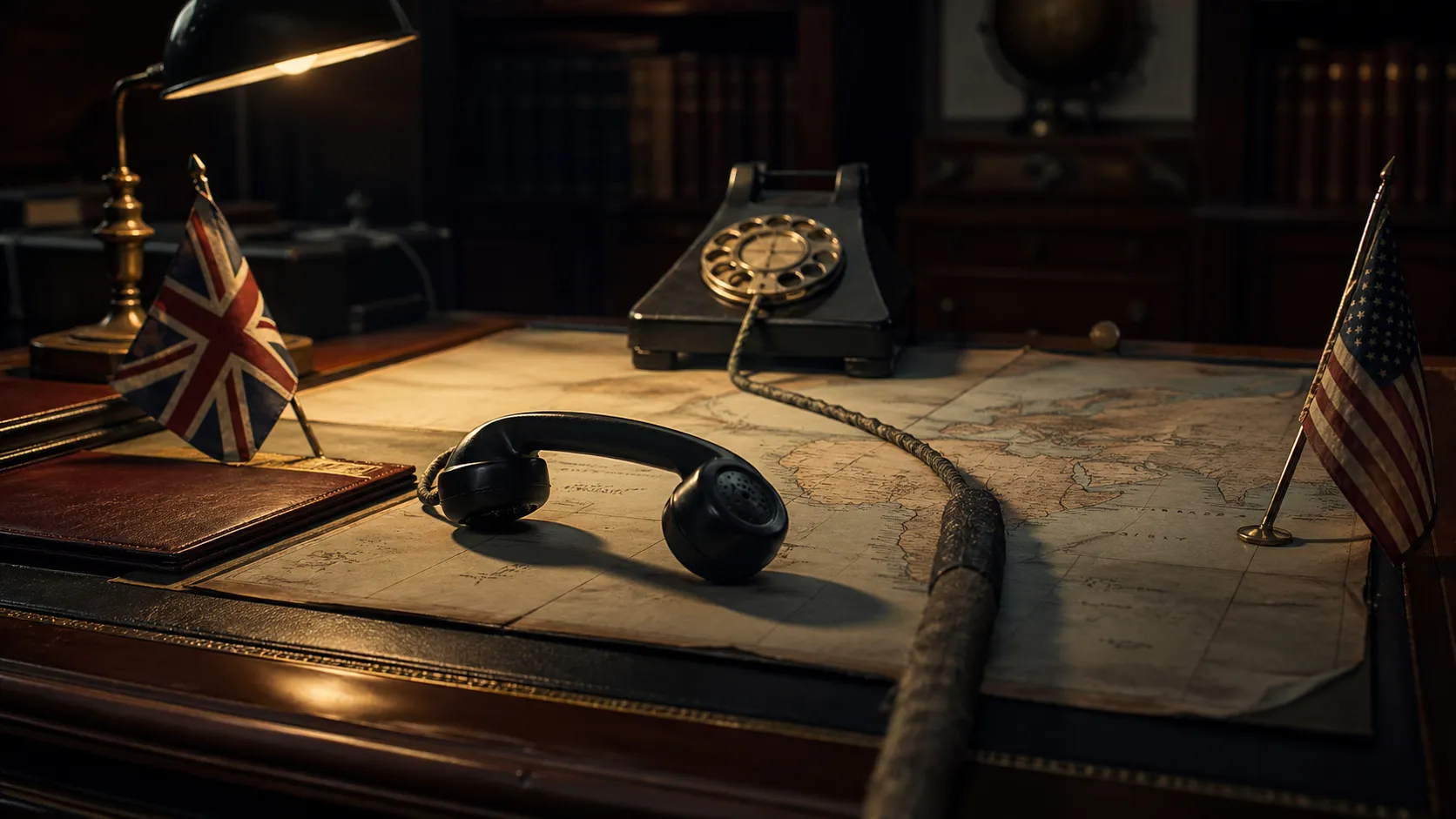
The U.S.–UK Special Relationship is, by most accounts, in its worst condition in living memory.
Donald Trump has spent most of his second term treating Keir Starmer less like a partner than an obstacle. In March, after the Prime Minister refused to let Washington use British bases to attack Iran, Trump declared on camera that "this is not Winston Churchill we are dealing with" and, in the same stretch of remarks, called the United Kingdom "very, very uncooperative with that stupid island." British policy on immigration and energy, he added elsewhere, is "insane." Asked by Sky News in April how he would characterize the Special Relationship, Trump reportedly replied, "With who?"
No sitting U.S. president has spoken about a British Prime Minister in this register before. Not publicly. Not on the record. Not with a microphone in front of him and the British ambassador a mile away.
And yet the Special Relationship has been here before, or somewhere close to here, and it was here during what most historians still regard as its golden era: the Reagan–Thatcher years. The portrait Trump hangs behind his desk is of a man who once presided over three serious, private ruptures with the woman he called "Margaret," each severe enough that in any of them the partnership could plausibly have cracked. It didn't, partly because of the temperaments involved and partly because of a quality that the current pair visibly lack: the ability to fight like adults with the phone on the hook.
The three episodes are worth revisiting now because they shed light on what the special relationship actually is, how it survives, and why the current version looks so much more fragile than it did in 1982.
The Phone Call at 11:30 at Night
The Falklands War is remembered in Britain as a moment of national restoration and in Washington as a somewhat embarrassing episode in which the State Department was caught leaning the wrong way. What is less often remembered is that at the end of May 1982, with British paratroops having taken Goose Green and preparing the assault on Port Stanley, Ronald Reagan picked up the phone and asked Margaret Thatcher to stop.
The call was placed at 6:03 p.m. Washington time on 31 May, which was 11:30 at night in London. It lasted seventeen minutes. Alexander Haig had proposed it. Bud McFarlane had approved it over the objections of John Poindexter, who seems to have anticipated the direction it would take. A transcript sits in the Foreign Relations of the United States series; an internal British note of the call, more candid about Thatcher's tone, sits in the Thatcher Foundation archive.
Reagan opened with Hollywood charm. He congratulated the Prime Minister on the "impressive military advance" and suggested, almost apologetically, that he might "impose" on her for a few thoughts. The thoughts, when they came, were not his own; they were the State Department's. The proposal was for a ceasefire to be arranged now, before the Argentine forces on the islands collapsed entirely, followed by a U.S.–Brazilian peacekeeping contingent, a phased British withdrawal, and internationally supervised negotiations over the islands' future. The best chance for peace, Reagan argued, was before complete Argentine humiliation. It was time, he said, for magnanimity.
Thatcher, in the phrase used later by the British official who drafted the record, was "too tough on RR."
She told him that Britain had not sent an enormous task force eight thousand miles across the Atlantic and had not lost British lives and British ships in order to hand the Queen's islands over to a contact group. She told him that Britain had gone into the islands alone, without outside help, and could not now allow the aggressor to profit from his aggression. And then, in the sentence that still stands out forty-four years later as a rare piece of genuinely undiplomatic language used by one allied leader to another, she asked him to imagine how he would feel if something similar had happened in Alaska.
"Just supposing Alaska was invaded," she said. "Now you've put all your people up there to retake it and someone suggested that a contact could come in. You wouldn't do it."
Reagan, by the account of the British ambassador Nicholas Henderson, barely got a word in. In his diary that night Reagan wrote: "The P.M. is adamant (so far). She feels the loss of life so far can only be justified if they win. We'll see; she may be right."
She was right. Port Stanley fell on 14 June. The junta in Buenos Aires collapsed within a year. The peacekeeping idea died on Thatcher's telephone line.
What is interesting about that call is not that the two leaders disagreed. What is interesting is that the disagreement happened at maximum volume and maximum clarity, in private, between two people who then got on with the business of the alliance the following week. Thatcher never briefed against Reagan publicly. Reagan never denounced Thatcher. The row stayed inside the room, which is where serious rows between allies belong.
The Pipeline That Broke the Room Open
A month later, and extending through most of the autumn of 1982, the two leaders found themselves locked into a second dispute, this one more substantive and more damaging. It did not stay inside the room.
The trigger was the Urengoy–Pomary trans-Siberian gas pipeline, a Soviet export project that several Western European governments, including the British, had contracted to help build. American firms were to supply compressors, pipe-laying equipment, and licensed technology. When the Polish government imposed martial law in December 1981, Reagan announced sanctions against Moscow, and on 22 June 1982, he extended them to cover overseas subsidiaries and licensees of U.S. firms. American technology already in European warehouses, already paid for, already destined for the pipeline, was suddenly embargoed retroactively.
The Europeans were furious. The British especially. The measure was read in London as extraterritorial overreach, as the United States was attempting to govern British commercial contracts from Washington. It was also, from a British industrial perspective, economically stupid: the contracts would be honored by someone since the Soviets were buying; the only question was whether it would be John Brown Engineering on Clydeside or a competitor in Japan.
On 1 July 1982 Thatcher stood up in the Commons and delivered a sentence that, in its quiet way, was as much a diplomatic slap as anything she had said to Reagan on the telephone. "The question is whether one very powerful nation can prevent existing contracts from being fulfilled. I think it is wrong to do that." A month later Britain's trade minister instructed British firms to ignore the American sanctions outright. France, West Germany, and Italy followed. The British Protection of Trading Interests Act was invoked to block the application of U.S. law inside the United Kingdom.
This was not a phone call at midnight. This was open defiance, conducted in legislatures and trade ministries, across several months, by the closest ally the United States had in Europe. The Reagan administration, internally split between a Pentagon that wanted the sanctions and a State Department that thought them ruinous, eventually folded. On 13 November 1982 George Shultz announced that the sanctions were being lifted in exchange for a fig leaf of coordinated allied measures on East–West trade, which everyone understood to be largely cosmetic. The pipeline was finished in 1984. The gas flowed. Western Europe became dependent on Russian energy for the next four decades, which is a longer story with its own consequences, but in the immediate term Thatcher had won.
What the pipeline episode demonstrates is that the special relationship has always been able to absorb serious, public, policy-level disagreement without cracking, provided both sides treat the disagreement as a disagreement about policy rather than as a personal affront. Thatcher did not call Reagan stupid. Reagan did not call Britain an island full of ungrateful bureaucrats. Each believed the other was wrong. Each said so. Neither attempted to humiliate the other, and neither pretended the row was something other than what it was.
Three O'Clock in the Morning in Augusta
The third episode is the most famous, and it is the one most often produced as evidence that the Special Relationship has survived worse. It is also, on closer reading, the least serious of the three, which is instructive.
On the morning of 25 October 1983, U.S. forces invaded Grenada, a Commonwealth member and a country whose head of state was the Queen. Thatcher learned about the operation a few hours before it happened, through a cable from Reagan that arrived, by her account, after the decision had been taken and while American ships were already in position. She was livid, and she was livid for good reason: the Foreign Office had assured the Commons that morning that no such invasion was imminent, on the basis of briefings from Washington that now looked either deceptive or incompetent.
Reagan called her the next day. The tape of that call, released by the Reagan Library in 2014, is one of the rare recordings of a private conversation between a President and a Prime Minister in the middle of a crisis, and it is worth listening to because it captures something about the two leaders that no written account quite manages.
Reagan is sheepish. He is, to use the appropriate word, apologetic.
"If I were there, Margaret, I'd throw my hat in the door before I came in," he says, reaching for a nineteenth-century Southern idiom about unwelcome visitors announcing themselves before entering, in case the hat got thrown back out. Thatcher, in no mood for folk charm, replies: "There's no need to do that."
Reagan then explains. He was woken at three in the morning while on a golfing vacation in Augusta. Commanders had only hours. The decision was driven by concerns about operational security and the safety of almost a thousand American medical students on the island. He regrets the embarrassment. He regrets it quite a lot.
Thatcher, having made her point by saying comparatively little, then gives him a way out. She tells him that she understands the sensitivities around secrecy, citing the Falklands as her own reference point. She asks about the prospects for restoring democratic government in St George's. She ends the call by noting she has a "tricky" debate in Parliament to return to, and Reagan tells her, with his usual sign-off, to "go get 'em and eat 'em alive."
It was in the Commons debate later that day that Thatcher took the actual public damage. She defended the operation in terms that satisfied almost no one, because she herself did not believe the defense she was offering. Privately she remained furious about it for years. But she did not break with Washington, and she did not allow Grenada to become the thing that defined 1983.
Three rows. Three different kinds of dispute. The pattern in all three is identical, and it is the pattern that is conspicuously missing from the current arrangement: both leaders believed that the alliance was more important than any individual argument within the alliance, and they behaved accordingly, even when they were absolutely certain they were right and the other side was absolutely wrong.
Trump does not believe the alliance is more important than any individual argument within the alliance. He has said as much, in those words, more or less, on several occasions. Starmer, for his part, does not have Thatcher's willingness to conduct a private war at midnight and shake hands in public the next morning, because Starmer is a careful lawyer and not a Lincolnshire grocer's daughter, and because no mechanism exists for a private war at midnight when one of the two parties broadcasts every grievance on a social network.
The current rupture dates, in concrete terms, to late February, when the United States entered its military campaign against Iran and expected British participation. Starmer, after a cabinet meeting that lasted, by some accounts, longer than it should have, declined. He called it "not our war." The UK subsequently allowed the use of Diego Garcia for what were described as "defensive" strikes, a concession that pleased no one: too much for the Prime Minister's own backbenchers and too little for Trump. The IMF has since revised British growth for 2026 down from 1.3 percent to 0.8 percent and officially cites the Iran conflict among the factors. A planned state visit by King Charles is being talked up in Whitehall as a stabilizing gesture. That is, in itself, revealing: when one country's answer to a diplomatic crisis is to deploy the monarch, the working-level relationship has already failed.
None of which means the Special Relationship is finished. It means the Special Relationship is, for the first time since the Suez Crisis of 1956, being conducted primarily at the level of the institutional plumbing rather than at the level of the two principals. Intelligence sharing under the Five Eyes arrangements continues. Naval cooperation in the Atlantic continues. The embassy on Grosvenor Square still functions. The machine runs, as the machine always runs.
What has gone is the thing Reagan and Thatcher had and that nobody since Blair and Clinton has really had in the same way: the willingness, at the top, to pick up the phone and have the argument. Thatcher rang Reagan at midnight because she trusted him enough to shout at him. Reagan rang Thatcher the morning after Grenada because he felt, genuinely, that he owed her an explanation. Neither of those sentences describes anything that has happened between the White House and Downing Street in the last fourteen months.
In the Falklands call, after Thatcher had finished making her point about Alaska, Reagan was recorded as saying, simply, "Yes." Just that. He had heard her, and he understood, even though he did not agree, and the conversation ended with both of them still on the line. That is what a working alliance sounds like, even when the two people running it cannot stand what the other is saying. Somebody has to be willing to stay on the call.