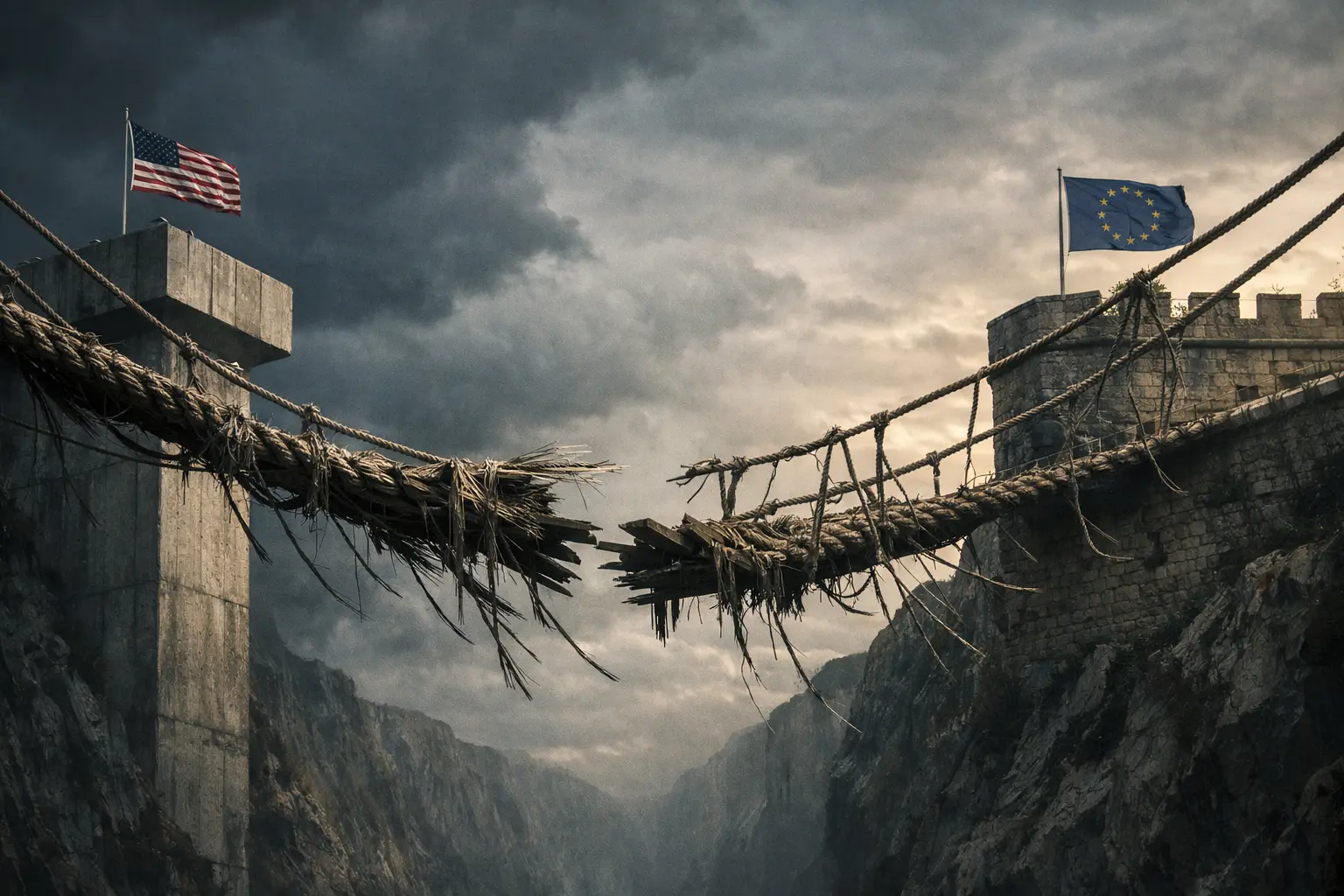
More than six weeks into the war against Iran, the capitals under bombardment are not the only casualties. The bombs are falling on Tehran, Isfahan, and Bandar Abbas. The diplomatic damage is being done in Brussels, Berlin, Paris, and London.
Transatlantic relations have weathered plenty of storms. Suez in 1956. De Gaulle pulling France out of NATO's integrated command in 1966. The bitter fracture over Iraq in 2003. Measured against those, the current moment is worse. Not because the individual disputes are more severe, but because the disputes have stopped being disputes about policy and started being disputes about whether the alliance means anything at all.
European diplomats keep repeating, with the strained cheerfulness of people holding a door shut against a storm, that nothing fundamental has changed. The reassurances from Berlaymont and the Quai d'Orsay grow softer as Donald Trump's posts on Truth Social grow louder. On April 12, after twenty-one hours of negotiations with Iranian officials in Islamabad collapsed, the US president announced a naval blockade of the Strait of Hormuz. He then turned his anger on the allies who had declined to join him.
"Be brave, go to the Strait and get it," he wrote. "You'll have to learn to fight on your own. The United States will no longer be there to help you, just as you weren't there for us." The responsibility for keeping the Strait open, he declared, would fall on "anyone who uses it." It was not, he said, America's job.
That line reflects something the Wall Street Journal reported in late March: Trump had told advisors more than once that he was prepared to end hostilities with Tehran even if the Strait remained closed. Through that waterway passes roughly one-fifth of the world's seaborne oil and a substantial share of its liquefied natural gas. The American president, in other words, was willing to let global energy supply remain throttled rather than let allies off the hook for what he considered their cowardice.
European leaders have signaled that they are willing to deploy naval units to the Gulf, but only after a durable ceasefire and only in a strictly defensive capacity. Macron, on April 13, announced a conference with Britain and other partners to organize a multinational mission. "This strictly defensive mission, distinct from the belligerents, will be deployed as soon as the situation allows," he wrote on X. The French president also dismissed Trump's idea of "forcibly liberating" the Strait as unrealistic. "When we want to be serious, we don't say the opposite of what we said the day before," Macron told reporters, drawing attention to Trump's habit of demanding European naval deployments one day and claiming the Strait would "open up naturally" the next.
How Europe Said No
The first government to break ranks was Pedro Sánchez. The Spanish prime minister accused Trump of having unleashed a conflict with unpredictable consequences and denied the United States access to Spanish airspace and to Morón and Rota for military operations against Iran. It was an unusually blunt move from a country that has historically been careful about its relationship with Washington.
Others were less direct but no less firm. Germany, under Friedrich Merz, was perhaps the most striking case. On March 3, Merz had sat beside Trump in the Oval Office and voiced qualified support for pressure on Tehran. Less than two weeks later, once the war was actually underway and the Strait was shut, his government had changed tone entirely. "This is not NATO's war," a spokesman for the chancellor said on March 16. Defense Minister Boris Pistorius was sharper still. "What does Trump expect a handful or two handfuls of European frigates to do in the Strait of Hormuz that the powerful US Navy cannot do?" he asked. "This is not our war. We have not started it."
France blocked the transit of aircraft carrying military supplies to Israel through its airspace. Italy, at the last minute, denied American bombers permission to take off from Sigonella. Estonia, the Netherlands, and the EU institutions collectively said no. Japan, Australia, and South Korea declined as well. A coalition of sorts did eventually emerge, a coalition of twenty-two nations willing to "contribute to appropriate efforts to ensure safe passage" once hostilities ended. It was the diplomatic equivalent of agreeing to help clean up after a party nobody wanted thrown.
The United Kingdom occupies an awkward middle position. Keir Starmer allowed the United States to use RAF Akrotiri and Diego Garcia for operations his own Foreign Office had described as legally dubious, while refusing to send British ships into the blockade and continuing to draw personal abuse from Trump on Truth Social. "We're not supporting the blockade," Starmer told the BBC. "Whatever the pressure, and there's been some considerable pressure, we're not getting dragged into the war."
When Starmer had earlier floated the idea of sending a British carrier group to the region as a gesture of solidarity, Trump rebuffed him publicly. "We don't need people that join Wars after we've already won!" he wrote. That was in early April. By mid-April he was complaining that the same allies had abandoned him. Consistency has never been the defining feature of this administration.
Trump's verbal attacks have not spared even those leaders who tried hardest to manage him. Giorgia Meloni, once held up in conservative American circles as Trump's natural European ally, was recently quoted by Corriere della Sera as the subject of a Trump interview. "I was wrong," he said. "She is the one who is unacceptable, because she does not care whether Iran has a nuclear weapon and would blow Italy up in two minutes if it had the chance." There is no version of Meloni's actual record on Iran that resembles this accusation. The point is not accuracy. The point is that Trump has decided every European leader is now a villain in the story he is telling himself.
A Strategy That Isn't Working
If Trump's frustration reveals anything, it is that the strategy is failing on its own terms. The threats to "wipe out" the Islamic Republic have not produced political collapse in Tehran. The regime, under strain and losing senior figures to Israeli strikes, is nonetheless proving adept at using the cards it holds. The Strait is one such card. Iranian oil exports are another.
The Economist reported on March 29 that Iranian crude exports had continued almost uninterrupted through the war, with daily volumes of roughly 2.4 to 2.8 million barrels, matching or exceeding 2025 figures. Most other Gulf producers have seen volumes collapse because shipping companies refuse to transit the Strait without insurance and without escort. Iran, operating a sanctions-hardened shadow fleet managed through networks connected to the Revolutionary Guards, has effectively been the main Gulf supplier for weeks. Tehran's daily oil revenues have nearly doubled compared to the pre-war baseline. The regime has even formalized the arrangement by enshrining the special revenues from unsanctioned tanker departures in its own legislation.
This is the central irony of Trump's war. It has enriched the regime it was meant to break.
Axios reported on March 31 that China and Pakistan have quietly advanced a proposal for ending the conflict: a ceasefire in exchange for the reopening of the Strait, with Beijing serving as the effective guarantor. China imports roughly 90 percent of its Iranian-origin crude and has every incentive to stabilize the arrangement. If such a deal materializes, Trump will likely declare it a triumph. He will also, in substance, have handed the diplomatic framing of Middle Eastern energy security to Beijing. Edward Luce put it well in the Financial Times: Iran has found a lever in global markets as potent as the one China discovered last year with rare earths. Even if Trump announces unilateral victory, Tehran now knows it has more influence than he does over American inflation.
Trump's April 2 Oval Office address made the contradictions visible. He threatened new strikes against Iranian energy infrastructure within two to three weeks, promising to send the country "back to the Stone Age" if no deal emerged. He insisted that regime change had "never" been the goal, which would surprise anyone who had read his Truth Social feed at any point in March. He thanked Israel and the Gulf states for their support. He told European allies to find the courage to police the Strait themselves. He assured American drivers that rising fuel prices were temporary and that there was no inflation, a claim the Bureau of Labor Statistics data flatly contradicted the following week.
The one subject he did not raise was ground forces. Polling has made clear that American voters will not tolerate another land war in the Middle East, and Trump, whatever else he is, can read a number. Without a ground option, he is left with airpower and a blockade, neither of which has brought Tehran to its knees and both of which are expensive.
NATO on the Edge
The transatlantic rift extends well beyond the Iran war. On March 26, the Telegraph asked Trump whether he had considered withdrawing the United States from NATO. "Absolutely," he said. "I was never convinced by NATO. I always knew it was a paper tiger, and Putin knows it too." He repeated the line to Reuters days later, describing the alliance as "severely weakened and extremely unreliable."
The legal barrier is real. Section 1250A of the fiscal year 2024 National Defense Authorization Act, signed by President Biden in December 2023 and sponsored in the Senate by Marco Rubio, now Trump's Secretary of State, prohibits any president from terminating, suspending, or withdrawing from the North Atlantic Treaty without either two-thirds of the Senate concurring or an explicit act of Congress. The same provision blocks the use of appropriated funds to effect such a withdrawal. Senate Democrats, forty-seven strong, have made clear they will not vote for withdrawal. A number of Republican senators, particularly those from states with significant defense industry presence, would also hesitate. The math does not work for Trump, at least not in the open.
That does not mean the alliance is safe. Ian Bremmer pointed out what everyone in Brussels already knew: if NATO members cannot trust that Washington will honor Article 5, the alliance is already broken in the way that matters. The formal treaty obligation is less important than the political assumption behind it. Trump has spent fifteen months systematically eroding that assumption, through tariffs, through territorial threats against Greenland, through his open flirtation with Putin, and now through a war he launched without consulting allies and then blamed them for not joining.
Rubio, asked about the alliance on Fox News in early April, said the quiet part aloud. "After this conflict is concluded, we are going to have to reexamine the value of NATO and that alliance for our country." This is the same man who three years ago sponsored the legislation designed to prevent a president from doing exactly that. The vector of travel is clear.
There is a practical problem that European defense ministries are only starting to acknowledge publicly. Most European militaries depend heavily on American equipment, which depends on American spare parts, software updates, and intelligence feeds. F-35s. Patriot batteries. HIMARS. Standard missile interceptors. What happens if a European operation that Washington disapproves of triggers a quiet slowdown in parts deliveries? The answer, increasingly, is that European operations may require de facto American consent even when no formal consent is required. The European defense industrial base, despite more than $450 billion in annual NATO-Europe defense spending, is still not capable of replacing American systems at scale. It is catching up, but catching up takes years.
The Europeans know this. It is why figures like Bart De Wever in Belgium have begun talking, with greater or lesser tact, about normalizing relations with Russia to recover cheap energy. It is why the discussion of European strategic autonomy has shifted from philosophical seminar to budget committee. It is why Macron convened the conference on the Strait of Hormuz in Paris rather than waiting for NATO to coordinate one. The pattern is unmistakable: Europe is reacting, but reacting slowly, and each step away from Washington is accompanied by the hope that the next American election will reverse the trajectory.
That hope is dangerous. Trump's imperial instinct and his contempt for Europe are not his alone. They are shared by Vance, by Rubio in his current incarnation, by Hegseth at the Pentagon, and by much of the younger Republican foreign policy cohort. A sizeable portion of the Republican electorate has come to see European allies as freeloaders at best and cultural adversaries at worst. Even if the Democrats win the White House in 2028, the political coalition that produced the current moment is not going to dissolve. Europe needs to build institutions and capabilities that survive not just Trump but Trumpism.
Richard Haass captured the dynamic in a phrase worth sitting with. The old American rule for Middle Eastern intervention, he noted, was the Pottery Barn rule: you break it, you buy it. Trump has inverted it. "We broke it," he is telling the Europeans, "but you own it."
The transition from alliance to something else is rarely the product of careful planning. It happens in moments of forced improvisation, when the familiar architecture stops working and the actors in the room have to decide, quickly, whether to patch it or build something new. That moment, for Europe, has arrived. What it does with the next six months will matter more than any summit communiqué pretending the relationship is fine.
A senior European diplomat, asked last week whether the alliance could still be saved, offered a response that captured the mood better than any official statement. "We are not asking whether the United States will come back," she said. "We are asking what we should build for the day it does not."