The End of an Age
The transatlantic alliance that we have known since 1945 is no longer there. There hasn't been a formal breakup, a break has been announced, or treaties have been pulled back. But the idea behind it, bringing together different interests, values, and a common vision for the international order, has broken down in a way that is hard to fix.
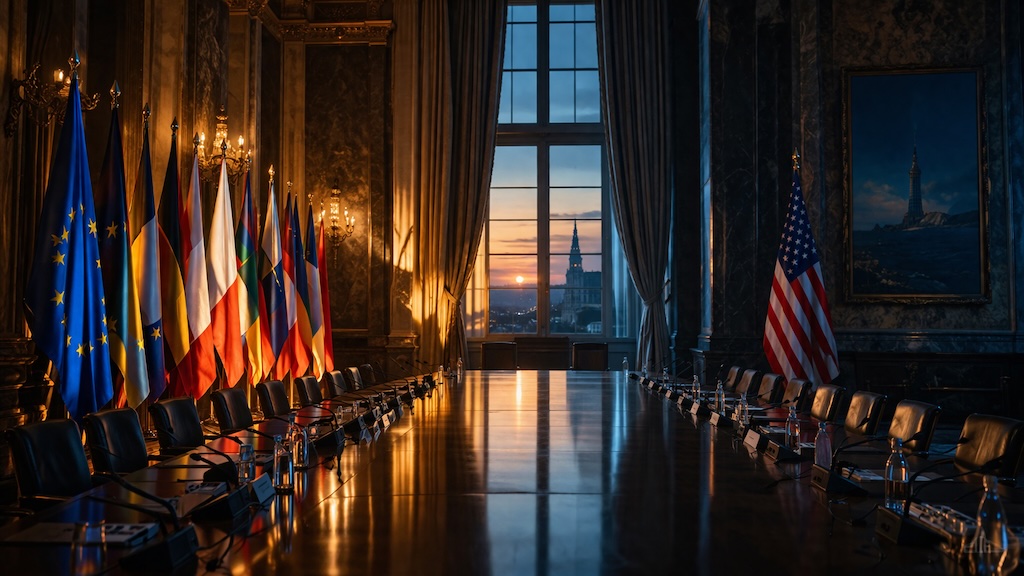
The 62nd Munich Security Conference took place from February 13 to 15, 2026, at the Hotel Bayerischer Hof. It did not confirm a sudden crisis. Instead, it made official a change that was already well underway. This year's conference report, called "Under Destruction," was written by the MSC under the direction of Chairman Ambassador Wolfgang Ischinger. It described a world where the forces of disruption are no longer on the edges but at the center of political power. Ischinger said before the conference that "transatlantic relations are currently in a significant crisis of confidence and credibility."
After hearing speeches from German Chancellor Friedrich Merz, US Secretary of State Marco Rubio, and EU High Representative Kaja Kallas, it was clear that this is no longer just about fixing the US-EU relationship. It is a matter of changing it completely from the ground up.
Democrats in Munich: Comfort Without Power
There were a lot of American Democratic officials at the conference, which made the hallways very crowded. Many of the people who were there are thought to be possible presidential candidates in 2028, and they used the world stage to show off their foreign policy skills. They included California Governor Gavin Newsom, New York Representative Alexandria Ocasio-Cortez, Michigan Governor Gretchen Whitmer, Senators Mark Kelly, Ruben Gallego, Chris Murphy, and Elissa Slotkin, and former Commerce Secretary Gina Raimondo.
These Democratic representatives tried to reassure their European counterparts that Donald Trump is "temporary" in both public comments and private conversations. Newsom was clear when he said, "Donald Trump is temporary. " He will be gone in three years. "California is a stable and trustworthy partner." He met with Chancellor Merz one-on-one and signed a memorandum of understanding for a new partnership with Ukraine's Lviv Oblast. However, on the sidelines of the conference, Newsom told CNN that many of the leaders he talked to see the United States as "a wrecking ball, unreliable, and, a lot of them think, irrevocable. " They don't think we'll ever go back to how we used to be.
Ocasio-Cortez took part in panels that linked economic inequality to the rise of authoritarianism around the world, but she got a lot of criticism for not being able to answer when asked if the US should protect Taiwan from a Chinese invasion. This mistake overshadowed her larger message about progressive internationalism. Senator Kelly gave the most honest opinion from the Democratic side: "What I'm hearing now is that even if we can fix these relationships, it will take generations before they feel at ease."
Marco Rubio, the main representative of the current US government, gave a speech that was much less harsh than Vice President JD Vance's fiery speech at the same conference a year before. Rubio called the US "a child of Europe" and talked about historical ties, common roots, and a shared future. He said that "the end of the transatlantic era is neither our goal nor our wish."
But these promises, which came from both sides of the American political spectrum, didn't seem to be enough. The 27 EU member states were worried about the Trump administration's aggressive stance on tariffs, its withdrawal from the Paris climate agreement and the WHO, its threats against Greenland, and a 2025 US National Defense Strategy that clearly says Europe is a "secondary theater." They talked openly about how to integrate European defense and the need for a security framework that doesn't rely solely on Washington.
Merz: A Diagnosis and a Plan
Many people said that Friedrich Merz's speech at the start of the conference was the most important speech by a German chancellor in Munich in decades. He was very clear in his opinion. He told the audience, "The international order based on rights and rules is being destroyed right now." "But I'm afraid we have to be even more blunt: this order, which was already flawed even when it was at its best, is no longer there."
Merz said that the Russian war of aggression against Ukraine, which will soon be four years old, was the start of a new phase of open conflicts that have changed the world in many ways. He said, "Together, we have crossed the line into an era that is once again openly defined by power and, above all, great-power politics."
But the chancellor's speech was more than just a diagnosis. It was also a clear rejection of the MAGA movement's cultural and ideological ideas. He talked directly about Vance's speech from 2025, in which the Vice President said that European democracies were hurting themselves by censoring free speech and letting too many immigrants in. Merz said, "There is a gap between Europe and the US." "Vice President JD Vance said this very clearly at the Munich Security Conference a year ago, and he was right."
Then came the important difference: Merz agreed that there was a rift, but he didn't agree with Vance's explanation of what caused it. He said, "The MAGA movement's culture war is not ours," and the crowd cheered. "Freedom of speech stops here with us when that speech goes against the Constitution and human dignity. We don't believe in tariffs or protectionism; we believe in free trade. We follow the World Health Organization and climate agreements because we believe that the only way to solve global problems is to work together.
Merz laid out a "Program of Freedom" with four points for Europeans to stand up for themselves. This included big increases in defense spending. For example, Germany promised to spend hundreds of billions of euros over the next few years, and the rest of Europe promised to raise core NATO defense spending from 2% to 3.5% of GDP. He talked about important traditional procurement programs in air defense, deep precision strikes, and satellite technology. He also talked about the revival of the German defense industry, with new factories, jobs, and innovative defense-tech clusters growing in Munich and other places, often with close cooperation with Ukraine. Germany's first permanent brigade deployment abroad, to Lithuania on NATO's eastern flank, showed how things had changed.
Most importantly, Merz said that he had started "private talks with the French president about European nuclear deterrence."" He made sure to point out that Germany would follow its legal obligations under the Nuclear Non-Proliferation Treaty and the 2+4 Treaty, and that any European nuclear framework would stay part of NATO's nuclear-sharing agreements. But the message was clear: for the first time since the end of the Cold War, Europe's biggest economy is seriously thinking about a future where the US nuclear umbrella might not be reliable.
Merz said that in a time of competition between great powers, "even the United States will not be strong enough to act alone." People may support authoritarian governments. Democracies have friends and partners. He told Washington to "fix and restore transatlantic trust together," but he also warned that Europe would not sit back and wait for that to happen. "Our freedom is no longer a given; it is in danger." To protect freedom, people must be ready to change and give up some things.
Rubio: Friends on Washington's Terms
Rubio's speech on February 14 was without a doubt the most anticipated. It was a message of peace at a time when tensions between the US and Europe were at an all-time high. Even though the US Secretary of State spoke in a reassuring way, the content was mostly the same as the administration's overall stance.
Rubio started with a broad historical view, talking about the Berlin Wall, the Cuban Missile Crisis, and the shared cultural heritage of Europe and America. He said, "Armies don't fight for ideas." "Armies fight for a way of life, a people, and a nation." He said that Europe was where the ideas that "planted the seeds of liberty that changed the world" came from. He said that the US "wants to work with Europe" and called America "a child of Europe."
But Rubio didn't talk about the European Union as a political force. He didn't say that the multilateral European architecture was still important, and he didn't support NATO as an unquestionable pillar like previous administrations had. As one major news outlet put it, his main point was that people should either join Trump's campaign to change the world for Washington's benefit or get out of the way.
Rubio also agreed with the administration's criticism of what he called "ill-designed policies," such as mass migration, what he called a "cult-like" approach to climate policy, and planned deindustrialization. These themes were very similar to those in the US National Security Strategy from December 2025, which said that "the real and more stark prospect of civilizational erasure" was more important than Europe's economic stagnation. This language caused a lot of backlash from European leaders.
Commission President Ursula von der Leyen said she was "relieved" by Rubio's tone, but many people at the conference were let down by the White House's message. The basic idea didn't change, even though there was talk of a "shared destiny." Washington doesn't want weak allies and doesn't plan to defend the old rules-based order. In this case, Europe is no longer seen as an important strategic partner. It is a helpful ally as long as it fits with American goals. The difference is big.
Rubio met with Merz one-on-one on the sidelines. Both the US and German governments say that they talked about the war in Ukraine, the state of talks with Russia, and a number of other issues, such as the situation in Iran and trade, before Merz's planned trip to China. Rubio talked about how Germany has helped Ukraine with $76 billion since 2022 and how Germany is working to make NATO stronger. However, the conversation was more about business than reaffirming alliance principles.
Kallas: No Conquest of Europe
Last year, European diplomats who were embarrassed by Vance's harsh criticism of the continent's democracies filled the halls of the Munich conference. There was at least a visible recovery in the Bavarian city over the weekend of February 13–15, 2026.
Kaja Kallas was in charge of the European response, which was direct and unapologetic. Under the title "Europeans Assemble!" the high representative gave her main speech. "Reclaiming Agency in a Rougher World" is a Marvel-inspired title that she made fun of by saying, "We are getting there, dusting off our capes, pulling on our boots, and revving up our engines."
Kallas flatly rejected the story, which had been revived in circles close to the US government, that Europe was "woke and decadent" and on its way to civilizational extinction. She told the audience that the EU is still an appealing political project and that countries from Ukraine to the Western Balkans are lining up to join. She said with obvious pleasure that during a recent trip to Canada, she learned that more than 40% of Canadians were interested in joining the EU. She joked, "The list of people who want to see you is getting long."
She said again that she supported transatlantic unity, but not at any cost. She said, "It's important to send the message that America and Europe are connected now and in the past and will be in the future." "It's clear that we don't agree on everything, and this will stay the same."
Then she said the most famous thing she ever said: a sharp response to American criticism of European limits on speech and media. "Coming from a country that is second on the Press Freedom Index, it's interesting to hear criticism of press freedom from a country that is 58th on the same index." The line was about how Estonia ranked second in the world on the Reporters Without Borders list, while the United States ranked 57th to 58th, depending on the year. Kallas said that all of the top 15 spots on the global Press Freedom Index are held by European countries.
Kallas said that Russia's goals go far beyond Ukraine when it comes to security: "Russia already wants to cripple economies with cyberattacks, disrupt satellites, sabotage undersea cables, break up alliances with false information, and force countries to comply by weaponizing oil and gas." She warned that giving Moscow more at the negotiating table than it had won on the battlefield was dangerous: "The biggest threat Russia poses right now is that it gets more at the negotiating table than it has on the battlefield."
People praised her performance, and she became famous for a short time. Politico called Kallas the "worst poker face" after she was caught on camera making a face during a speech by US Ambassador to the UN Mike Waltz, who gave his fellow panelists a "Make the United Nations Great Again" (MUNGA) hat. This event, for many, showed the difference between American performative diplomacy and European frustration.
The Nuclear Question: A Crucial Moment
The most important thing that happened at MSC 2026 may have been that the highest levels of politics talked about a European nuclear deterrent that was not linked to the United States. This is a turning point in how people think about security in Europe after the Cold War.
Merz's revelation of "confidential talks" with Macron set the stage. Hours later, French President Emmanuel Macron talked more about the topic at the conference. He said that Europe "has to become a geopolitical power" and that the current security systems won't work in the future. Macron went further than any other French president before him by suggesting "command capacities at the European scale. "This is a big change from France's long-held view that its nuclear weapons are only for its own use.
Macron suggested a "new strategic dialogue" about nuclear weapons that would include "special cooperation, joint exercises, and shared security interests with some key countries." He made it clear that this effort was connected to the relationship between France and Germany: "This dialogue is important because it's a way to talk about nuclear deterrence in a broader context of defense and security." This is a way to bring Germany's and France's strategic culture and strategic approach closer together.
British Prime Minister Keir Starmer added to the momentum from across the Channel by saying at the conference that the UK was "enhancing our nuclear cooperation with France" and that "any adversary must know that in a crisis they could be confronted by our combined strength."
There are a lot of practical problems. France has about 290 nuclear warheads that can be delivered by submarine-launched ballistic missiles and Rafale fighter jets that can launch cruise missiles from the air. The UK still has its Trident deterrent on submarines, but it is very dependent on US technology. No one thinks that a European deterrent will replace the US umbrella in the short term because these arsenals don't have as much firepower as the huge Russian and American stockpiles. Finnish Defense Minister Antti Hakkanen spoke for many when he said that "investing more in the Franco-British nuclear capability is only a good thing," but that "to compensate US nuclear deterrence is not realistic at this point."
Independent experts say that a credible European deterrent would cost at least €50 billion and take decades to build. For this project to work, states would have to give up their sovereignty over the most important choice any government can make: whether or not to use nuclear weapons. The MSC Security Report itself gave Europe five nuclear options, but it warned that none of them are good and that "there is no low-cost or risk-free way out of Europe's nuclear predicament."
Still, a group of 11 European defense experts warned in a paper given at the conference that "Europeans can no longer outsource their thinking about nuclear deterrence to the United States."
Munich 2026: Not a Break, But a Change
The 62nd Munich Security Conference did not allow a break. It allowed something that could be seen as more important: the end of interdependence as a natural, unquestioned part of the transatlantic relationship.
The language used at the conference stayed polite. But the substance changed in a big way. Europe knows that its relationship with the United States has changed in a big way, not just because of one administration, but because of deeper changes in American politics, demographics, and strategic direction. The US National Defense Strategy clearly calls Europe a "secondary theater." This is not something that started during Trump's presidency; it is part of a bipartisan shift toward the Indo-Pacific that started before he took office.
According to Commission President von der Leyen, European defense spending has gone up by almost 80% since before the full-scale invasion of Ukraine. NATO members have agreed to raise their core defense spending to 3.5% of GDP. They will also set aside an extra 1.5% for investments in security. The EU budget for 2026, which is €192.8 billion, puts defense, security, and strategic resilience first. In March, Germany's Bundestag voted to change the Basic Law so that the military could spend a lot more money. There are a lot of new defense-tech clusters growing all over the continent. New factories, technologies, and partnerships are bringing the European defense industry back to life. Many of these partnerships were made in Ukraine.
The main political question now is whether European leaders can get their people to agree that these changes are necessary. The sacrifices that need to be made, like cutting public spending, giving up strategic independence, and being willing to take risks, are real and big. Merz himself said this: "Freedom is no longer a given; it is under threat." People who want to protect freedom must be willing to accept change and give up some things.
"An alliance used to be a promise," wrote one Euronews analyst after the fact. Today, it's a short-term deal. Europe has a tough road ahead. But not many people can say they weren't warned after Munich 2026.