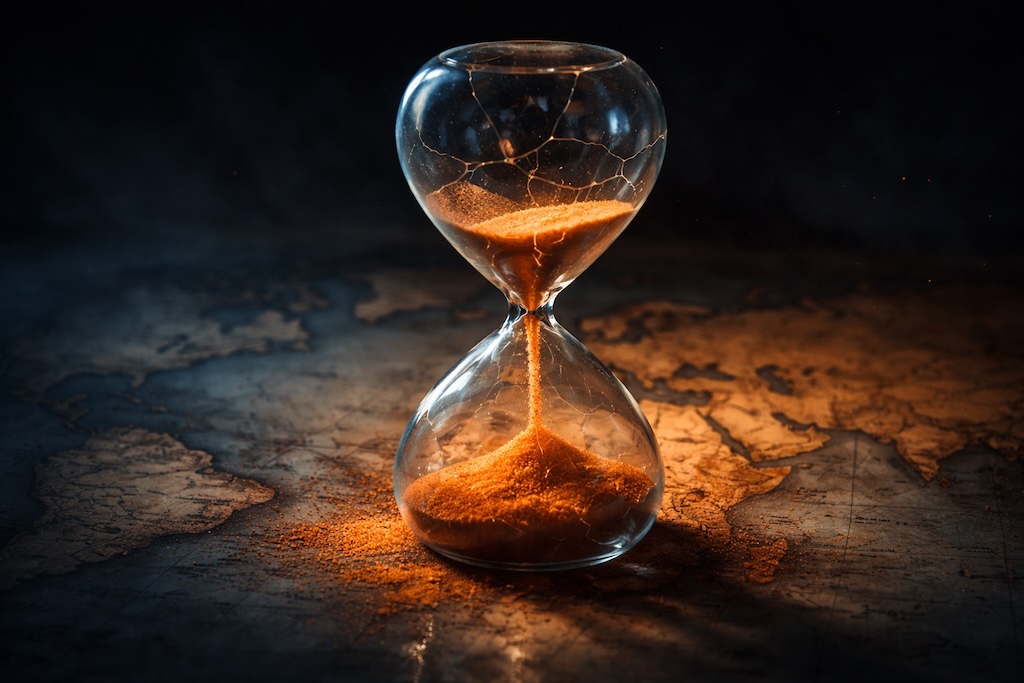
New START, the last thing that could have stopped the spread of nuclear weapons, has run out. The return of the nuclear threat hangs over the world, even though people are talking to each other informally and don't trust each other.
The New Strategic Arms Reduction Treaty (New START), which was the last nuclear arms control agreement between the US and Russia, officially ended on February 5, 2026. The two biggest nuclear powers in the world, the US and Russia, are no longer limited by any legally binding limits on their strategic arsenals. This is the first time this has happened since the SALT I talks began in 1972. They have about 90% of the world's estimated 12,241 nuclear warheads. The end of the treaty has raised fears of a new global arms race and brought about what many experts call the most dangerous nuclear era in decades.
In 2010, Presidents Barack Obama and Dmitry Medvedev signed a treaty in Prague that limited each side to 1,550 deployed strategic warheads on no more than 700 deployed delivery systems (intercontinental ballistic missiles, submarine-launched ballistic missiles, and heavy bombers). There was also a limit of 800 deployed and non-deployed launchers. It also set up a strict system for checking and inspecting things that made things clear and predictable, which were the most important things for strategic stability during the nuclear age. But the treaty didn't limit the number of warheads that were kept in reserve storage and weren't being used, which was thought to be in the thousands on each side.
The Path to Expiration
The end of New START didn't happen all at once; it was the result of years of worsening relations between the U.S. and Russia and the gradual breakdown of the whole arms control system.
In 2021, newly elected President Joe Biden and Moscow agreed to use the treaty's one-time, five-year extension clause, which pushed the treaty's end date to February 2026. But there was a catch: the extension couldn't be renewed without renegotiation and ratification, which is almost impossible to do in the current political climate.
The next blow came when Russia fully invaded Ukraine in February 2022. By August 2022, Moscow had stopped letting people inspect its nuclear weapons in person. Then, on February 21, 2023, President Vladimir Putin officially pulled Russia out of the treaty. However, he made it clear that Russia would still follow the numerical limits. The US thought Russia wasn't following the rules, so it cut back on some of its own data-sharing duties.
Putin made a big offer in September 2025, just before the treaty was set to end. He said that Russia would continue to follow New START's quantitative limits for one year after the treaty ended, until February 2027, as long as the US did the same and didn't do anything that Moscow thought would destabilize the situation, like putting missile defense interceptors in space. At first, White House Press Secretary Karoline Leavitt said the plan was "pretty good." President Donald Trump even told a TASS reporter that it "sounds like a good idea to me." But before the deadline passed, the U.S. didn't make any official promises.
Trump called New START a "badly negotiated deal" and pushed for a new, modernized treaty that would include China. During his first term, he backed out of the Open Skies Treaty and the Intermediate-Range Nuclear Forces (INF) Treaty.
Last-Minute Negotiations in Abu Dhabi
Axios said that U.S. envoys Steve Witkoff and Jared Kushner had talked with Russian officials on the side of peace talks in Abu Dhabi on the same day the treaty ended. Sources who know about the talks say that the two sides were getting close to an informal agreement to keep following New START's main limits even after the treaty officially ends. The treaty would still officially end on time, even though the agreement wouldn't be legally binding. Two sources warned that the draft agreement still needed to be approved by both President Trump and President Putin, which had not yet happened.
A U.S. official said that the plan was to work out a new deal instead of bringing back New START, but both sides had agreed "not to stray from the deal in the meantime." At the same time, the U.S. European Command said that military-to-military talks with Russia would resume. These talks had been on hold since 2021, when Russia invaded Ukraine. This also came up in the talks in Abu Dhabi.
There is a historical precedent for these kinds of informal agreements. The US and the Soviet Union agreed to follow the unratified SALT II Treaty in 1981. This agreement helped keep strategic stability while the two sides worked out what would become START I, which was signed ten years later in 1991.
The Chinese Element
The main reason the Trump administration has been hesitant to just extend or copy New START is that it doesn't include China, and China's nuclear weapons stockpile is growing faster than ever.
The Stockholm International Peace Research Institute (SIPRI) says that China's stockpile went from about 410 warheads in 2023 to about 500 by January 2024 and then to over 600 by January 2025. This means that China is adding about 100 new warheads every year, which is the fastest growth rate of any nuclear-armed country. The Pentagon's 2025 annual report said that Beijing is on track to have more than 1,000 warheads by 2030 as part of what it called China's "massive nuclear expansion."
By the beginning of 2025, China had finished or was close to finishing about 350 new ICBM silos in six places: three in the north's desert regions and three in the east's mountainous areas. SIPRI says that China could have ICBM capabilities similar to those of Russia or the United States by the end of the decade, depending on how Beijing organizes its military. For the first time, experts think that some Chinese missiles now have warheads attached to them during peacetime patrols. This ends Beijing's long-standing practice of keeping warheads separate from delivery systems.
China has no interest in joining any arms control agreement. Guo Jiakun, a spokesperson for the Chinese Foreign Ministry, dismissed SIPRI's findings, saying that China has a "no first use" policy and keeps "the minimum level of nuclear arsenal required for national security." Beijing has said that it is "neither fair nor reasonable" to include China in talks about disarmament when the US and Russia have more than 10,600 warheads, which is more than China's 600.
But the raw numbers only tell part of the story. China's quick modernization, which includes missiles that can carry multiple warheads, hypersonic glide vehicles, and a nuclear triad that is becoming more mature with land-based, sea-based, and air-delivered systems, is a major change that changes the way both Washington and Moscow think about strategy.
The Tinderbox of South Asia
The article's warning about a possible nuclear domino effect was proven true in May 2025, when India and Pakistan had their most intense military conflict in more than 20 years.
The April 22 terrorist attack near Pahalgam in Indian-administered Kashmir, which killed 26 civilians, mostly Hindu tourists, set off the crisis. India blamed the militant groups Jaish-e-Mohammed and Lashkar-e-Taiba, which are based in Pakistan. On May 7, India started Operation Sindoor, which involved cruise missile strikes on militant infrastructure in Pakistan, including targets in the heartland of Punjab. This was the first time India used cruise missiles against Pakistan. They used the BrahMos (which they made with Russia) and the European SCALP-EG.
Pakistan responded with mortar attacks, drone strikes, and, for the first time, short-range ballistic missiles with conventional weapons aimed at Indian territory. For four terrifying days (May 7–10), the two nuclear-armed neighbors fought each other with drones, missiles, cyber attacks, and artillery in many different areas. India hit Pakistani air bases in 11 cities, and Pakistan sent more than 300 Turkish-made Songar drones to attack 36 sites. The New York Times said that Indian attacks near the Nur Khan air base, which is close to the headquarters of Pakistan's Strategic Plans Division, which is in charge of its nuclear weapons, made Washington very worried that the conflict was getting closer to a nuclear war.
On May 10, a weak ceasefire was reached with the help of the U.S. While Vice President J.D. Vance was talking to Indian Prime Minister Narendra Modi, Secretary of State Marco Rubio was on the phone with Pakistan's army chief. Both Indian and Pakistani military leaders said that neither country ever thought about using nuclear weapons. But many people saw Pakistan's Nuclear Command Authority meeting on May 9 as "soft" nuclear signaling, aimed more at the United States than at India, to get the US to step in.
Matt Korda, a researcher at SIPRI, said that "the combination of strikes on nuclear-related military infrastructure and third-party disinformation risked turning a conventional conflict into a nuclear crisis." The episode clearly showed that nuclear weapons don't stop wars and that they can make mistakes much more dangerous in some situations.
The Domino Effect: Pressures to Grow
Without binding arms control, the threat of nuclear proliferation goes far beyond the nine countries that currently have nuclear weapons. A competitive dynamic that is multi-dimensional is starting to take shape:
India–China–Pakistan triangle.
As China builds up its military, India may feel the need to do the same, and Pakistan will almost certainly try to keep India in check. In 2024, India added a few more nuclear weapons to its stockpile. It is also working on new "canisterized" missiles that can carry nuclear warheads during peacetime and may be able to carry more than one warhead per missile once they are ready to use. Pakistan also kept working on new ways to deliver things and stockpiling fissile material.
The most recent U.S. National Security and Defense Strategy (November 2025) left out long-standing promises to protect allies from nuclear attack in South Korea and Japan. Countries like South Korea are worried about this silence because public polls have shown that most people there support building their own nuclear deterrent. Japan has 47 tons of separated plutonium, which is enough for thousands of weapons, and it has world-class missile technology. So far, it hasn't made weapons because of political opposition at home and U.S. security guarantees. But if people lose faith in those guarantees, the math could change.
Saudi Arabia's past statements and the way security works in the Middle East make people wonder what its long-term nuclear plans are. Iran's advanced nuclear program is still a worry for the spread of nuclear weapons.
The NPT is in danger: The Nuclear Non-Proliferation Treaty (NPT) from 1970 says that countries that don't have nuclear weapons promise not to get them in exchange for nuclear powers making good-faith efforts to disarm. A review conference for the treaty is set for 2026. The failure of bilateral arms control between the two biggest nuclear arsenals goes against the "grand bargain" that is at the heart of the treaty.
The Doomsday Clock says it's 85 seconds until midnight.
The Bulletin of the Atomic Scientists, which was started in 1945 by Albert Einstein, J. Robert Oppenheimer, and other scientists from the Manhattan Project, moved the Doomsday Clock to 85 seconds to midnight on January 27, 2026. This was the closest it had ever been to disaster in its nearly eight-decade history.
The setting, which was four seconds closer than the previous year's 89 seconds, showed what the Bulletin's Science and Security Board called a "failure of leadership." Daniel Holz, a professor at the University of Chicago and chair of the Board, said, "The dangerous trends in nuclear risk, climate change, disruptive technologies like AI, and biosecurity are accompanied by another frightening development: the rise of nationalistic autocracies in countries around the world." The Board came to the conclusion that "Russia, China, the United States, and other major countries have become increasingly aggressive, adversarial, and nationalistic," which has destroyed hard-won global agreements and sped up a great power competition where the winner takes all.
This is the annual clock's answer to a basic question that people asked Robert Oppenheimer in 1947: Is humanity in more danger now than it was last year? Yes, the answer is a strong yes in 2026.
The AI Wild Card
The SIPRI Yearbook 2025 added another, less well-known aspect to nuclear risk: the growing use of AI in military decision-making. AI systems that are meant to speed up crisis response, from finding early warning signs to targeting and command-and-control, could cut down on the time it takes to make decisions to just a few minutes or seconds, which doesn't leave much room for human judgment.
The risk isn't just from intentional use. Artificial intelligence (AI) that misreads satellite images, electronic signals, or enemy movements could set off a chain of automated responses that makes a crisis worse before political leaders have a chance to step in. The margin for error gets even smaller when there are no transparency mechanisms like New START, which make it harder for enemies to see each other's force postures and plans.
The Bulletin's 2026 statement specifically mentioned "the increasing sophistication and uncertain accuracy of AI models" as a reason for setting the clock, and it warned that AI use in military programs is a "significant concern."
The Quiet in Munich
The Munich Security Conference in mid-February 2026, which is usually a great place to talk about global security issues, was interesting because it didn't talk about much. As EU Reporter pointed out, there wasn't much talk about New START's end. Instead, the main topic of discussion was how to make the European military stronger. Ursula von der Leyen, the president of the European Commission, talked about the need for a "European backbone of strategic enablers. " Kaja Kallas, the EU's foreign policy chief, talked about protecting Europe, making its neighborhood more stable, and building stronger global partnerships.
Many people found it very troubling that there was no real discussion about the failure of nuclear arms control or the EU's possible role in getting everyone back to the table to talk. Some people said that the conference's overall tone, which called for more military spending and capabilities, made them think of the Cold War-era idea of "peace through strength." Some people said that the conference's overall tone, which called for more military spending and capabilities, made them think of the Cold War-era idea of "peace through strength."
A Weakened Deterrence in a Changing World
Nuclear deterrence is becoming more important in great power relations again, but the international order is becoming more unstable, more complicated, and more multipolar at the same time.
During the Cold War, deterrence worked in a fairly simple way between two superpowers. They both had a good idea of each other's strengths and weaknesses, set red lines, and, most importantly, wanted to avoid destroying each other. The nuclear landscape today is very different. Nine states have nuclear weapons. There are a lot of nuclear-armed pairs that are fighting each other in the same area. New technologies like hypersonic weapons, cyber capabilities, and AI-enhanced command systems are breaking down the ideas that traditional deterrence was based on.
Matt Korda, a researcher at SIPRI, gives a sobering assessment: "Nuclear weapons do not guarantee safety." The recent rise in violence between India and Pakistan shows that nuclear weapons don't stop wars. On the other hand, they pose huge risks of escalation and terrible mistakes, especially when there is a lot of false information, and they could make a country's people less safe.
In other words, a new race to build nuclear weapons would not make the world safer. It would raise the possible cost of making a mistake, and in the nuclear field, one mistake could end civilization.
What's Next?
There is a way forward, but it's not easy. There are still a number of choices:
Short-term: If the informal agreement in Abu Dhabi holds, both the U.S. and Russia may continue to follow New START's numerical limits on their own. This would be a symbolic but important way to build trust while more formal talks are going on. The SALT II precedent indicates that informal agreements can last for many years.
In the medium term, any new agreement will have to deal with the fact that there are now many nuclear powers in the world. The US says that China has to be included in any new framework. Russia has made another request: that the UK and France be included as well. China won't take part as long as its weapons stockpile is smaller than those of Washington and Moscow. To get past this deadlock, we'll need creative diplomacy and probably a step-by-step plan. For example, we could start with limits between the U.S. and Russia and then work on separate ways to deal with China.
Long-term: The Treaty on the Prohibition of Nuclear Weapons (TPNW) went into effect in 2021 and now has 70 countries that have signed it. However, none of the nine countries with nuclear weapons have signed it. Its continued growth sends a political message that most of the world thinks nuclear weapons are not legitimate. This message may become stronger as the arms control system continues to break down.
The Collapse of Political Imagination
If the potential employment of tactical nuclear weapons is no longer considered taboo—if terms like "limited nuclear war" and "nuclear signaling" have become normalized—the responsibility does not rest with the weapons themselves but with the inadequacy of political leadership to comprehend the associated risks, and the perilous misconception that absolute power can be exercised without absolute repercussions.
The time without binding nuclear limits is not just a technical or diplomatic issue. It's a test of political imagination to see if the leaders of the world can find the will to create new rules for a time when there are many nuclear powers, new technologies, and broken trust. If they don't, the cost of their failure will be too high to fix.
The time is 85 seconds until midnight. Every second matters.